Belém and the Amazon
Belém is the capital of Pará, in the Brazilian Amazon, and it is the cradle of carimbó, a rhythm and dance of Afro-Indigenous origin. That fact is the starting point for understanding the city’s cultural identity. Belém is also the city of the Círio de Nazaré, one of the largest religious processions in Brazil, with music and singing. The Ver-o-Peso market and Amazonian gastronomy are part of the same identity. These elements—music, dance, religious procession, market life, and food—are not isolated topics. They belong to a city whose culture is rooted in the Amazon and in the meeting of African and Indigenous traditions. For readers of Brazilian music, Belém matters because carimbó is not a distant folkloric reference. It is a living rhythm and dance connected to the place that calls itself its cradle.
What is carimbó
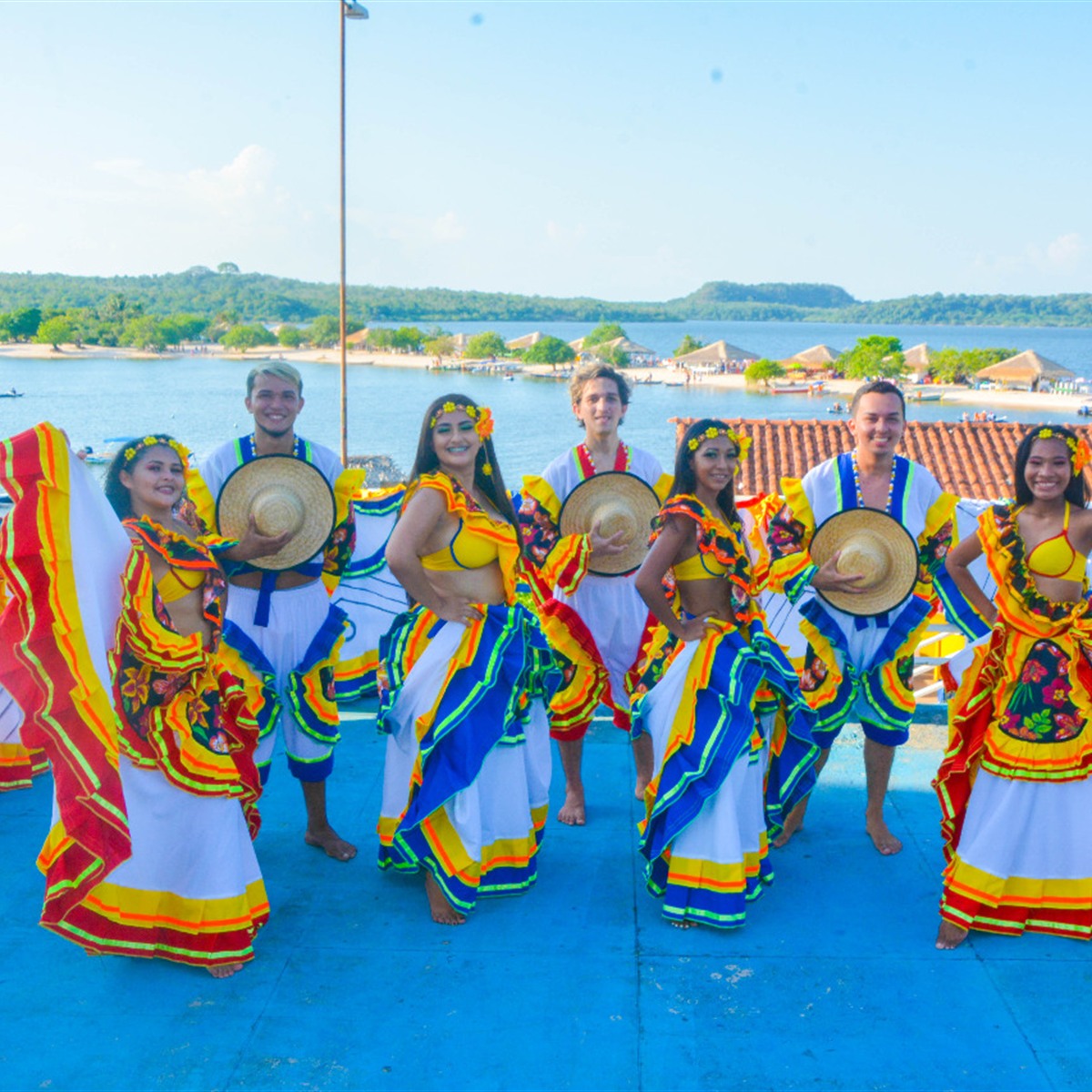
Carimbó is a rhythm and dance of Afro-Indigenous origin, and Belém is its cradle. It is both music and movement: drums provide the rhythmic base, and the dance gives the tradition a visible, collective form. The dance is performed in a circle, with wide skirts and marked movements. These features are simple to list but important to understand. The circle places the dancers around the music rather than in a fixed stage arrangement. The wide skirts and marked movements give the dance a recognizable style. Carimbó is not only a sound to be listened to; it is a practice that involves the body, the group, and the space of the circle. In Belém, carimbó belongs to the city’s cultural identity, and it is one of the clearest expressions of the Afro-Indigenous heritage of the Brazilian Amazon.
Instruments and dance
The facts about carimbó are clear: it is played with drums and danced in a circle, with wide skirts and marked movements. The drums are the instrumental foundation. They carry the pulse and support the dancers. The circle is the social and visual frame of the dance. It brings the participants together and makes the dance a shared event rather than a spectacle separated from the audience. The wide skirts are part of the visual identity of the dance, and the marked movements give the body a clear, defined language. When these elements combine, carimbó becomes more than a rhythm: it becomes an embodied tradition. The relationship between drumming and dancing is central. The drums set the pace, and the dancers answer with movement. This is why carimbó is best understood as a rhythm and dance together, not as separate pieces.
Círio de Nazaré and music
Belém celebrates the Círio de Nazaré, one of the largest religious processions in Brazil, with music and singing. The Círio is a religious event, and music and singing are part of it. That combination is important for understanding the city’s soundscape. In Belém, public life includes both the rhythm of carimbó and the music of a major religious procession. The facts do not say that carimbó is the music of the Círio; they show that Belém is a city where music and singing accompany one of Brazil’s largest religious processions. For visitors, the Círio is a major event. For the city, it is a central moment of religious and cultural life. The presence of music and singing in the Círio confirms that Belém’s identity is deeply musical, and that music appears in different contexts, from dance to procession.
Ver-o-Peso and the culture of the city
The Ver-o-Peso market and Amazonian gastronomy are part of Belém’s cultural identity. The market is not just a place to buy goods; in the context of the facts, it is one of the cultural markers of the city. Amazonian gastronomy belongs to the same identity. Together, the market and food show that Belém’s culture is lived in daily spaces, not only in festivals or performances. This matters for a music publication because it reminds us that sound is connected to place. The same city that gives us carimbó also gives us Ver-o-Peso and Amazonian gastronomy. A cultural visit to Belém should therefore include the market and the food, just as it should include carimbó and the Círio de Nazaré. These are different expressions of a single urban and Amazonian identity.
How to experience it and what to listen to
To experience Belém and carimbó, begin with the defining elements: drums, circle dance, wide skirts, and marked movements. Listen for the drum foundation, and watch how the dance is organized in a circle. If you want to explore Brazilian music beyond the obvious, Brecilia’s music section is a useful starting point. For a radio approach, Brecilia Radio offers another way to listen. For more context and articles, visit the Brecilia blog. When you are in Belém, pay attention to the Círio de Nazaré, one of the largest religious processions in Brazil, with music and singing. Also make time for the Ver-o-Peso market and Amazonian gastronomy, which are part of the city’s cultural identity. Carimbó is not only a rhythm to hear; it is a dance to see and a tradition to respect. In Belém, rhythm and city belong together.
What is Carimbó from Belém do Pará and what instruments does it use?
Carimbó is an Afro-Indigenous circle dance and musical genre from the Amazonian state of Pará, Brazil, officially recognized as Brazilian Intangible Cultural Heritage by IPHAN in 2014. Its driving rhythm is played on hollowed-log drums called curimbós, accompanied by maracas, Amazonian banjo, ganzá shakers, and flutes.
Where can you hear live Carimbó in Belém do Pará and who are its key artists?
Visitors in Belém do Pará can experience authentic Carimbó circles in the pottery district of Icoaraci, the historic Cidade Velha waterfront, around the Ver-o-Peso market, and on Marajó Island. Iconic masters of the genre include Mestre Verequete, Pinduca, Mestre Lucindo, and Dona Onete; to explore another cornerstone of Brazilian music, read our guide to Rio de Janeiro, samba, and Carnival.