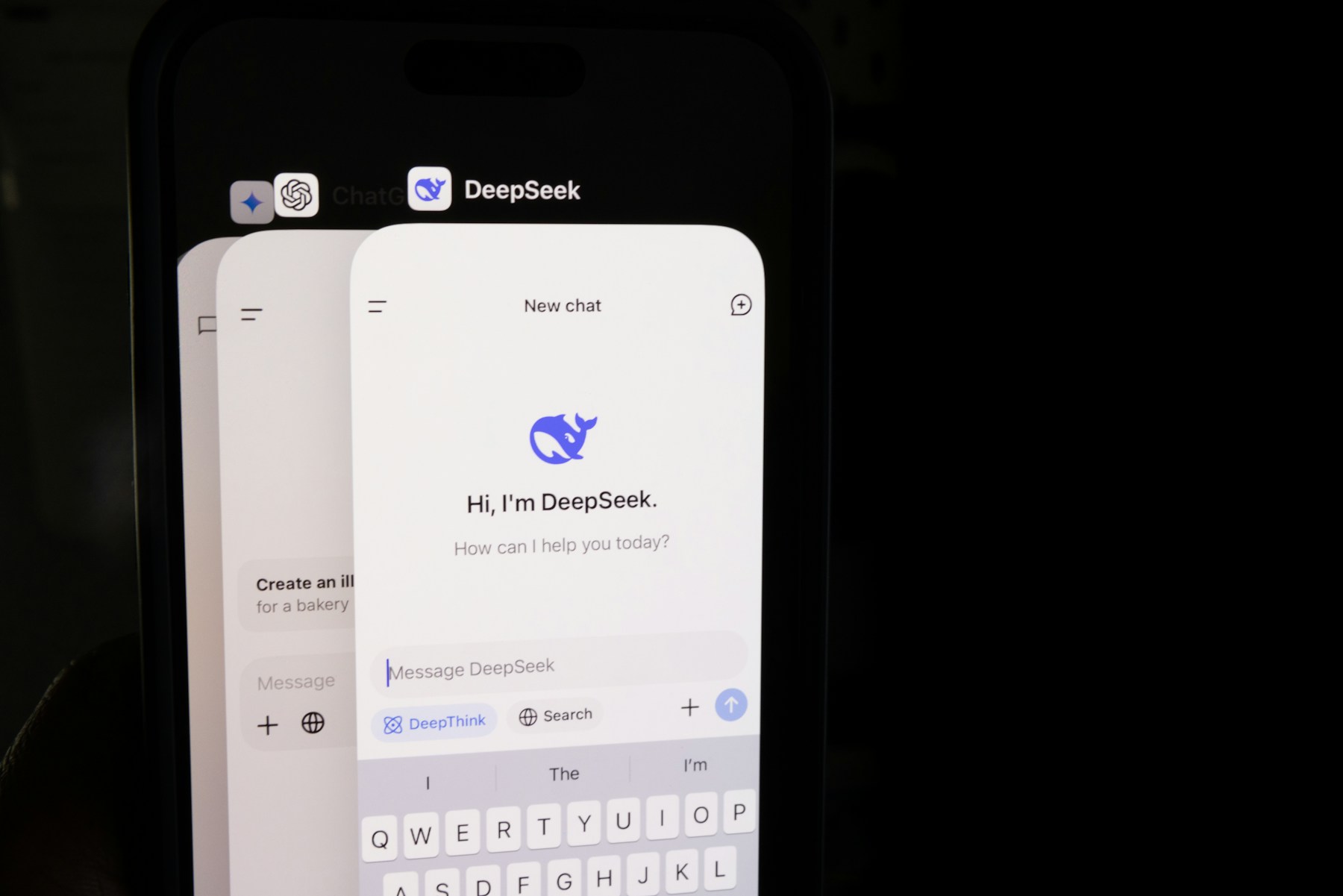
The announcement seems simple: the United States has ordered DeepSeek removed from the computers of its civilian federal agencies. But behind that headline is a story with dates that matter, a restriction broader than the word “app” suggests, and a debate that does not end at the U.S. border. Was DeepSeek banned for everyone? What happens with programs that incorporate its models? What should a company in Nicaragua that uses artificial intelligence to serve customers, produce content or process documents learn from this episode?
The answer starts by reading the order, not just the headlines. The official notice published in the U.S. Federal Register appeared on October 20, 2026, although the signed document is dated July 24, 2026. It was made available to the public on October 19. That difference is essential: what became widely known this week is not a universal ban that suddenly emerged on Tuesday.
What the United States actually ordered
The measure comes from the Department of Homeland Security (DHS) and targets the civilian agencies of the federal executive branch within its authority. It requires them to exclude the products and services of Hangzhou DeepSeek Artificial Intelligence Co., Ltd. and its affiliated entities from their technology purchases, and to remove covered products from their systems.
The text goes beyond the mobile app or the chatbot someone opens in a browser. It includes third-party products and services developed using DeepSeek implementations. That is a decisive distinction: an organization may not have the official program installed and yet use an enterprise solution that depends on one of its models.
The Reuters coverage of the order and the analysis by TechCrunch of its scope agree on that point. This is not an order aimed at every person living in the United States, nor a ban announced for private users in Nicaragua.
The chronology that changes the headline
The official appendix identifies the instruction as Exclusion and Removal Order #2026-01 and gives July 24, 2026 as the original issuance date. The notice was made available for public inspection on October 19 and formally published on October 20. The difference explains why some media outlets speak of a new ban and others of an earlier decision that has just been made public.
It also avoids a practical mistake. The document allows exceptions to be requested in writing within 60 days after the order was issued. It does not say that this period begins again with the October publication. Therefore, it would be incorrect to announce that agencies now have an additional 60 days to seek authorization or that all of them have 60 days to complete the removal. The order requires immediate action, with a specific procedure for exceptions.
The signed text accompanying the notice provides that an agency must justify why it needs an exception, identify the affected products and propose measures to reduce risks. The Cybersecurity and Infrastructure Security Agency, CISA, reviews those requests. This is not an open door to ignore the restriction: it requires a documented decision.
Why DeepSeek is at the center of the debate
DeepSeek became a visible player in global artificial intelligence competition by offering models capable of reasoning, coding and text generation with a distribution strategy that made experimentation easier for developers. Its emergence intensified a question that once seemed reserved for a small group of companies: how much does it cost to build and use competitive AI systems?
That openness also complicates risk assessment. You have to distinguish between chatting with a service hosted by a company, accessing a model through an intermediary API and running a downloadable version on your own infrastructure. These are different forms of use and can involve different data paths. The fact that a model has weights available to developers does not automatically mean every service built around it stores information in the same place.
That is precisely why the scope of the order has attracted attention. The Register examined the difficulty of identifying third-party integrations: in complex systems, a company may access models through gateways or vendors that do not always make it obvious which engine is chosen for each request. The obligation to inventory technological dependencies can be more cumbersome than uninstalling an app.
The alleged risks are not proven incidents
The DHS bases its decision on possible avenues of information exposure, the legal framework applicable to a company operating in China and security vulnerabilities that, according to the agency, deserve attention. Its concerns include the possible transfer of sensitive data, user tracking and the use of information to obtain intelligence on U.S. entities.
The right verbs matter: the document warns of risks; it does not prove that every DeepSeek installation stole information, that all versions contain malware or that every user suffered a breach. Confusing a risk hypothesis with a confirmed incident would turn an important news story into an accusation that the evidence consulted does not support.
There are concrete technical precedents, but they also have limits. In February 2025, the security firm NowSecure released its analysis of the DeepSeek iOS app. It reported data transmission, cryptography and privacy mechanism issues in the version examined. That study referred to a mobile app and a specific moment; it cannot be extended without evidence to all versions, to Android, to a local installation or to the security status of October 2026.
The data question: where it is processed and who is responsible
The privacy policy published by DeepSeek indicates that information collected by its service may be stored on servers located in the People’s Republic of China. That is relevant for an entity that manages citizen information, internal records or confidential materials. However, that policy corresponds to the service described by the company; it does not replace an analysis of the architecture of each third-party implementation.
For any organization, the useful question should not be only “which AI brand do we use?” It is also necessary to know what data leaves your own systems, who receives the requests, which provider runs the model, how long logs are retained, what controls exist and how access is managed. Those questions apply to DeepSeek and to any other provider, whether American, European or Asian.
A policy may establish that data processing is lawful in one jurisdiction and still be incompatible with another entity’s obligations. That is why governments assess security, privacy, public procurement and operational continuity separately. Not all of those discussions lead to a general ban; some result in contracts, audits, technical controls or restrictions on very specific uses.
China responds and the discussion becomes diplomatic
Beijing’s response was not long in coming. In the October 20 press briefing of China’s Foreign Ministry, spokesperson Mao Ning rejected the expansion of the concept of national security to technological and commercial matters, and said her government will defend the legitimate interests of Chinese companies.
The Associated Press account of the Chinese response presents the decision as a new point of friction between two powers competing to develop and control strategic technologies. Washington speaks of supply and data risks; Beijing denounces discriminatory restrictions. These are different official positions, and neither removes the need to examine the verifiable content of the order.
The discussion also reaches trade. If public institutions begin to demand traceability of the models used, software providers will have incentives to explain their dependencies more clearly. That possibility does not mean that all private companies must abandon DeepSeek. For now, the document examined regulates the civilian federal U.S. sphere described in it.
What this measure does not mean
It does not mean that DeepSeek has disappeared from the internet. The news does not announce the worldwide shutdown of the service or its mandatory removal from private phones.
It does not mean that Nicaragua has imposed a similar restriction.In the sources reviewed, there is no equivalent Nicaraguan provision related to this order. Presenting it as a ban currently in force in the country would be incorrect.
It does not mean that all open models are insecure.The availability of code or weights, the location of servers, the conditions of an API, and the security of an application are related but distinct issues.
Nor does it mean the decision is purely technical or purely political.The document includes security concerns and comes in a context of international competition. Coverage by Bloomberg Law and BleepingComputer helps separate legal authority, compliance requirements, and the operational questions that remain open.
What a company or creator in Nicaragua can learn
For a small Nicaraguan business, the direct effect of this order may be nil. The value of understanding it lies in anticipating problems that can arise when artificial intelligence tools are used in customer service, music production, document management, e-commerce, or digital communication.
Let’s think of a business that uses an assistant to reply to messages. If the system receives names, phone numbers, conversations, or customer documents, it is worth knowing the path those data take before choosing the cheapest or fastest model. The same criterion applies to an agency that processes job applications, a media outlet that investigates sources, or an artist who uploads unpublished material to external services.
In a creative project, artificial intelligence can expand possibilities without replacing editorial judgment. Brecilia has already addressed that idea from another angle in its article about the role of AI as a music producer's tool. Here the lesson is complementary: in addition to deciding what a tool can create, you have to decide what information it can be trusted with.
Five questions worth more than an improvised ban
Before integrating any AI service into a business, it is worth checking whether the provider identifies where it processes data; whether it allows the use of information for training to be limited or disabled; whether records can be deleted; whether there is a clear party responsible in the event of incidents; and whether a third-party solution changes models without notice. These questions are not a legal assessment nor do they guarantee absolute security, but they help turn concern into a concrete decision.
It also makes sense to distinguish public materials from personal data or business secrets. A promotional description does not pose the same risk as a customer database, payroll records, or a confidential document. Security does not depend solely on choosing a well-known brand: it requires configuring access, reviewing contracts, and preventing sensitive information from ending up in services that were not approved to receive it.
A story about trust, not just a chatbot
The DeepSeek story in October 2026 leaves a broader lesson. When a technology is incorporated into many applications, its risks and its advantages travel with it. Governments may respond with restrictions, companies with audits, and users with more demanding questions about privacy. Each response has different costs and consequences.
The verifiable fact is this: a U.S. order signed on 24 July, publicly released on 19 October and published in the Federal Register on 20 October 2026, requires the removal of technologies linked to DeepSeek from covered civilian federal systems and excludes them from certain procurements. China has rejected the measure. The practical application to third-party services still raises questions that should not be answered with assumptions.
For Nicaragua, the news should not translate into automatic fear or blind trust. It should open a more useful conversation: who controls our data, how the tools we use are documented, and what responsibility we assume when artificial intelligence begins to become part of everyday work. Innovation matters. Knowing where its limits are matters too.