What El Güegüense Is and Why It Matters
El Güegüense — also known as Macho Ratón — is a satirical street drama from Nicaragua, a synthesis of Indigenous and Spanish cultures that combines theatre, dance and music. That triple nature is part of what makes it unusual: it is not a play staged behind a proscenium, nor a dance performed for its own sake, but a form in which word, body and sound move together through the street.
The work satirizes colonial authority through wit and humour. Rather than confronting power head-on, it operates through ingenuity — a strategy of language and gesture that turns deference into mockery. For that reason it is considered one of the most distinctive cultural expressions of the colonial period in Latin America.
Its oldest texts date from the early eighteenth century, which places the drama among the oldest living theatrical traditions of the region. That date is not an antiquarian detail: it shows that the critical voice the drama carries was formulated early and has been re-staged continuously, generation after generation, in the same regional setting. That a text of that age is still performed, in the same town, as part of a patronal festival, is the core of its importance.
Diriamba and the Festivities of San Sebastián
El Güegüense is performed in Diriamba, in the department of Carazo, during the patronal festivities of San Sebastián, held from 17 to 27 January; the day of San Sebastián itself falls on 20 January. The drama is thus tied to a specific place and a specific calendar: it belongs to the festival, and the festival belongs to the town.
Diriamba, in Carazo, is the geographic reference for anyone approaching the tradition, and the ten-day window is its temporal one. For visitors, this means the work is not available on demand. It lives inside that January period, in a civic and religious context that gives it its rhythm. Understanding that frame — that El Güegüense is one element of a patronal celebration rather than an isolated show — changes how one watches it.
More on the cultural calendar and related coverage can be found at More information on brecilia.
Characters, Masks and Costume
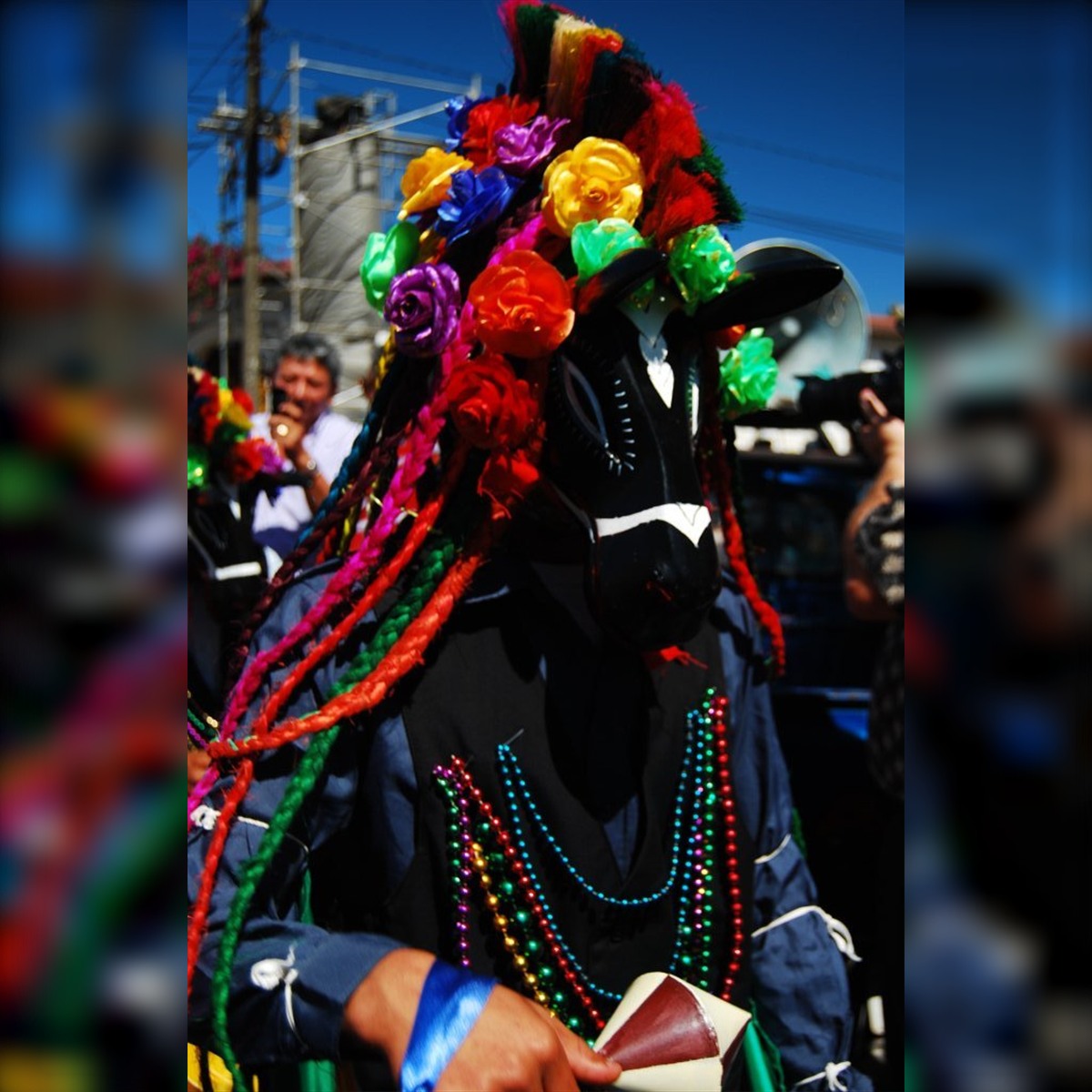
The performers wear masks of carved wood and colourful costumes. The masks are not decoration: they are the means by which the drama's figures are identified and, in a sense, the means by which the satire is delivered. A carved face permits a character to say what a bare face could not.
The colourful costumes complete the transformation, and their palette contributes to the street's visual character — one reason the drama is remembered by spectators as much as an image as a text. Because the work integrates theatre, dance and music, the visual and the sonic dimensions are not secondary to the words; they carry part of the argument.
The Music: Violins, Guitars and Drums
The music is performed with violins, guitars and drums. The combination is modest in its forces and specific in its colour: bowed strings, plucked strings and percussion. Within a street drama, this instrumentation is practical as well as expressive — portable enough to move with the performance, resonant enough to be heard in the open.
Given that El Güegüense is a synthesis of Indigenous and Spanish cultures, the ensemble can be heard as that synthesis in sound. For listeners who want to approach the tradition through recordings and related programming, More information on radio brecilia is a place to begin; our music section at More information on music brecilia covers further listening.
How to Experience It: Practical Notes
The first practical point is the calendar. The representation takes place in Diriamba, Carazo, within the festivities of San Sebastián, from 17 to 27 January, with 20 January as the saint's day. Plan around that window, and treat the festival as the container of the drama rather than an accessory to it.
The second is expectation. This is a street drama that combines theatre, dance and music; it unfolds in public space, alongside the religious and civic life of the festival. Come ready to stand, to move, and to follow the performance as it occurs rather than as a fixed programme.
The third is attention to the whole. Watch the masks of carved wood, the colourful costumes, and listen for the violins, guitars and drums together — the satire operates through all three at once. For background reading before or after, see More information on brecilia.
Why It Remains Alive: The UNESCO Value
In 2005 UNESCO proclaimed El Güegüense a Masterpiece of the Oral and Intangible Heritage of Humanity, and in 2008 it was inscribed on the Representative List. These are recognitions of a living practice, not of a monument.
The recognition matters for a simple reason: a tradition that satirizes authority through wit and humour survives by being performed. Its continuity depends on the town, the festival dates, the mask carvers, the costumed dancers and the musicians with violins, guitars and drums. UNESCO's listings place the drama within a global framework of intangible heritage, but the drama itself remains local — performed in Diriamba, in Carazo, from 17 to 27 January, as it has been since texts were set down in the early eighteenth century.
That is the double value of El Güegüense: a colonial-era satire considered among the most distinctive cultural expressions of the colonial period in Latin America, and a January festival in a Nicaraguan town that keeps it in the street.
What is El Güegüense of Diriamba and why did UNESCO recognize it as Intangible Heritage?
Proclaimed a UNESCO Masterpiece of the Oral and Intangible Heritage of Humanity (2005; inscribed 2008), El Güegüense —also known as Macho Ratón— is a 17th–18th-century satirical street drama from Diriamba, Carazo, blending Spanish-Nahuatl dialogue, masked dance, and colonial music. Its plot follows a shrewd Indigenous elder who outsmarts Spanish colonial officials using wit, puns, and feigned deafness.
When is El Güegüense performed in Diriamba and what instruments accompany the dancers?
Traditional street performances fill Diriamba every January —peaking between January 17 and 27 during the San Sebastián patron-saint festivities— featuring masked characters such as El Güegüense, Don Forsico, Governor Tastuanes, colonial ladies, and flower-crested Macho Ratón dancers. The traditional sones are played on violin, guitar, reed pito flute, snare drum (tambor), and metal chischiles rattles; to discover another heartland of Nicaraguan music and dance, read our guide to Masaya, cradle of Nicaraguan folklore and bow marimba music.