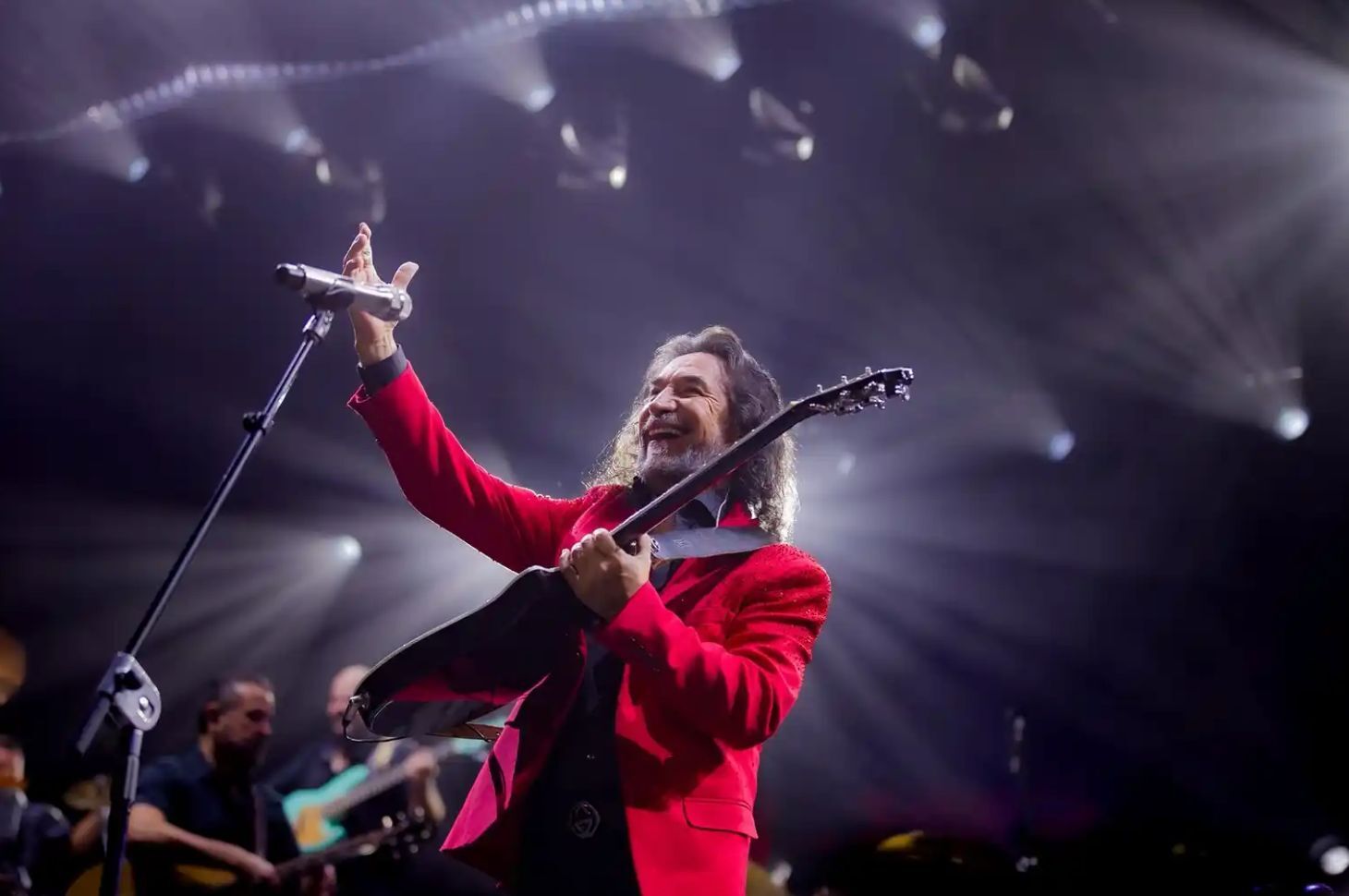
There are songs you don’t need to look for: they appear on their own when a guitar starts playing, when someone sings them from another room, or when a family gathering falls quiet for a moment. Marco Antonio Solís’s music has a lot of that. His ballads have moved from Los Bukis to his solo career and, along the way, have become tied to loves, farewells, and memories that each person recognizes in their own way.
On Friday November 20, 2026, Solís will perform again in Managua, at the Estadio Nacional Soberanía, with his Gratitud Tour. The date appears on the artist’s official calendar and on the Ticketera Nicaragua box office. For Nicaragua, this is neither a debut nor an isolated visit. It is the return of an artist who has been meeting this audience for decades.
The return that already has a history
The Nicaraguan press archive gives the November announcement another layer of depth. In June 2006, La Prensa described more than 15,000 people singing along to his songs at the Estadio Nacional Denis Martínez, even after a rainy afternoon. That account preserves a very concert-like image: muddy shoes, people singing “Si te pudiera mentir,” and an artist who thanked them for being back in Nicaragua. In 2008, the newspaper announced another Solís performance to close the year in Managua.
In March 2015, La Prensa Gráfica reported that Solís was performing in the country for the fifth time. It was a more-than-two-hour night at the National Football Stadium; the audience sang his ballads and also danced. That concert was tied to Teletón: the organizers announced that part of the proceeds would go to that cause. In the middle of the show, Solís thanked the Nicaraguans and said he sang with soul and heart. A record of that night remains in the coverage by La Prensa Gráfica.
There is something lovely about the new meeting arriving under the name Gratitud. There is no need to assign the tour a promise that has not yet been explained in detail in order to feel that the name speaks to that history: an audience that has welcomed him before and an artist who has expressed, on different visits, his gratitude for returning.
Marco Antonio before he was El Buki
His full name is Marco Antonio Solís Sosa. He was born on December 29, 1959, in Ario de Rosales, Michoacán, Mexico, into a family of seven children. Music did not arrive as a sudden discovery in adulthood: as a child, he sang at his town’s parties and fairs, and he learned to play guitar around the age of 12. In an interview with La Voz de Michoacán, he recalled his father’s guitar and the school moment when he first noticed the attention his voice could draw.
He studied at Colegio Hidalgo de Ario de Rosales. The biographical sources consulted speak of that period and of his musical training since childhood; I did not find reliable data to attribute university or conservatory studies to him. In a conversation published by El Comercio, Solís said he had once considered the priesthood. Music, which had already begun accompanying him at school and at home, eventually became his profession.
With his cousin Joel Solís, he formed his first duo. The history of that project gradually expanded into Los Bukis, where Marco was lead vocalist, songwriter, and producer. There, some of the songs that still remain attached to his name were written, including “Falso amor” and “Tu cárcel”. After nearly two decades with the group, he began his solo path; En pleno vuelo, released in 1996, shaped that new stage without erasing the previous one.
That continuity is part of what makes a Solís night special: you don’t have to choose between remembering Los Bukis or listening to the solo artist. The two stories coexist on the same stage. Those who want to learn more about that journey can read our review of Marco Antonio Solís and Los Bukis, which focuses on his biography; this new piece complements that profile with the story of his return to Nicaragua.
Songs that found their own path
“Si no te hubieras ido” is one of those songs whose life extended far beyond a single recording. Solís wrote it in 1983, and Marisela was the first to record it on disc. He recorded it with his own voice for Trozos de mi alma, in 1999. In an interview with Billboard, he recalled how the song reached new audiences through other versions. The song kept changing performers without losing the sense of absence that made it recognizable.
“Tu cárcel” was born in the Los Bukis era. Solís has said he began writing it in Torreón in 1986, during a period of exhaustion and tension. The story it tells is not complicated: someone leaves in search of a better life, and the one who stays tries to put words to the wound. Perhaps its strength comes from that, from saying something painful without overloading it. El Siglo de Torreón recounts the composer’s memory; El Universal revisits the song’s history and inspiration.
The origin of “La venia bendita” seems lighter: Solís said the melody came to him on a flight between Mexico City and Cancún, and that he wrote the idea on a napkin. The song ultimately became one of his best-known solo pieces. The anecdote appears, along with the stories of “Tu cárcel” and “Si no te hubieras ido”, in this Latin Times interview with Billboard.
Those songs are joined by “Más que tu amigo”, “Mi eterno amor secreto”, “¿A dónde vamos a parar?” and “Dónde estará mi primavera”. They do not all come from the same era or say the same thing; some bear the mark of Los Bukis and others belong to his solo career. But each one has the ability to trigger a memory with very little: a phrase, a melody, the voice of someone singing it from across the table.
Solís’s career has also been recognized by the industry. The Latin Recording Academy named him Person of the Year 2022; the artist’s official site highlights his five Latin Grammys. They are part of a more than five-decade career as a singer, songwriter, and producer.
What we know about the night in Managua
The date of November 20 and the Estadio Nacional Soberanía appear on the artist’s schedule and in ticket sales. Nicaraguan media have followed the news from the announcement of the tour to the release of the seating sections. TN8 and Canal 4 gave the date and venue; later, TN8 and La Nueva Radio YA published the prices.
What has not yet been confirmed is the start time, who will open the show, or which songs will make up the Managua setlist. I think it’s important to say that, because many topics are mentioned in the promotion and in the press notes, but that does not turn an expectation into an official setlist. It is reasonable to imagine the night will travel through stages of Los Bukis and his solo career; we’ll have to wait for the production announcement to know how it will be ordered.
The sections and the price of each experience
The Ticketera Nicaragua box office shows prices from US$45 to US$300, with the service fee included. Gramilla costs US$45 (C$1,674) and is standing room only. Zona Reef, also standing room only, costs US$55 (C$2,046); General grandstand costs the same. Right Garden and the left and right preferred grandstands cost US$85 (C$3,162); the box office specifies that the preferred sections are first come, first served. For those looking for a seat, Platinum is priced at US$140 (C$5,208), AMEX B at US$220 (C$8,184) and AMEX A at US$300 (C$11,160). The córdobas equivalents correspond to the exchange rate of C$37.20 that appeared on the page when I checked it.
I wouldn’t choose a section just because of the name “Platinum” or “AMEX”. First I’d look at the official map and ask myself how I want to experience the concert. If I want to stand and be close to the energy of the gramilla, the US$45 option is the most accessible ticket. If I prefer a seat, I’d compare Platinum with the two AMEX sections and carefully check their location. The preferred section can be an in-between price point, although the order of arrival affects how the spot is obtained.
I can’t call one section “the best view” without a clear stage layout that allows angles and visibility to be compared. The sale shows left and right options and lets you consult the map; for an informed purchase, it’s best to open it, review the conditions, and confirm the current price before paying. The presale announced for American Express BAC clients began in August; now you have to go by the availability shown on Ticketera.
Singing the same songs again
In 2006, according to La Prensa’s report, Solís thanked the audience for its support and affection. In 2015, after another concert in Managua, the media reported that he thanked the Nicaraguans and spoke of singing with soul and heart. Now, in his most recent message, he expresses that he wants to reunite with his followers. There is no need to invent a story between those visits: it is enough to look at how the gesture of returning, singing, and giving thanks repeats itself.
For me, that is the meaning of this new date. It is not just about hearing a collection of hits, but about seeing how a song written decades ago finds a new place when thousands of people sing it together. Marco Antonio Solís returns to Managua on November 20. The date and seating sections have been published; the time, guests, and setlist are still awaiting confirmation. Anyone planning to go can start by checking the map and choosing the ticket that best fits their budget and the night they want to experience.
The date, venue, and seating sections were checked in the artist's official calendar and in Ticketera Nicaragua. Information about previous visits comes from the linked reports by La Prensa and La Prensa Gráfica. At the time of preparing this review, the time, guest artists, and setlist for Managua had not been publicly confirmed. Prices and availability may change; it is advisable to check the links before buying.
Cover photo: miggell1 / Wikimedia Commons. License Creative Commons Attribution 2.0. 2006 image; presentation crop.