Recife, Olinda and the Carnival of Pernambuco
Carnival in Brazil is often reduced to one image: a wide avenue, sequined costumes and a slow build towards a week of parades. Recife and Olinda, in Pernambuco, offer something else, and for many visitors it is the most singular carnival in the country. The rhythm here is fast and brassy, the streets are steep and colonial, and the crowds move to two traditions that carry the region's history on their shoulders: frevo and maracatu. They are not decorative add-ons to the party; they are the reason the party has the shape it does. One is a dizzying, athletic dance performed under colourful umbrellas; the other is a procession of drums rooted in Afro-Brazilian tradition. Together they explain why carnival in Pernambuco feels like a street festival rather than a spectacle, and why so many people plan a trip around it. If you want to arrive already familiar with the sound, our music section is a good place to start.
What Is Frevo
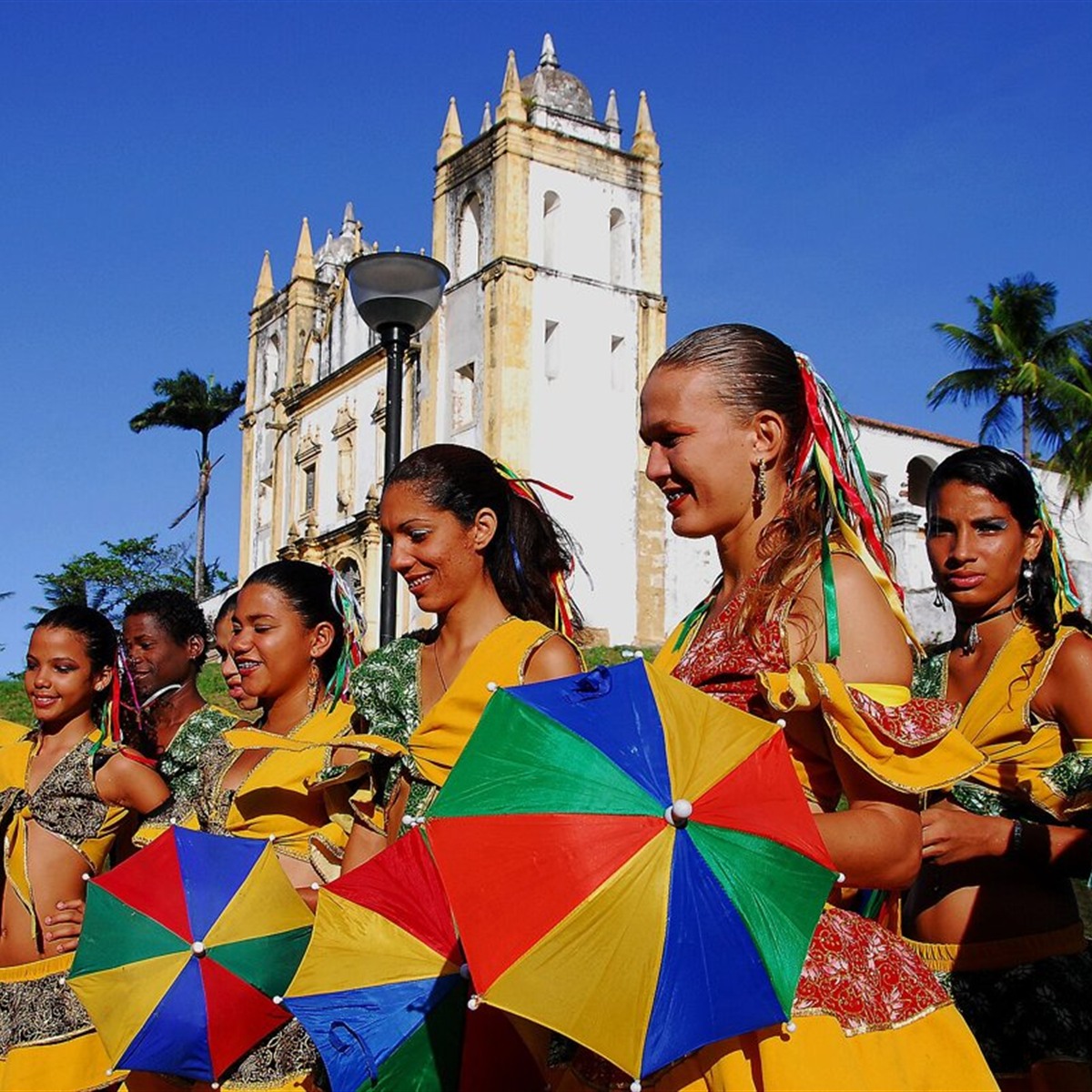
Frevo is a music and a dance, and the two are inseparable. The music is fast — genuinely fast, built on a driving, brass-led pulse that pushes forward without pause — and the dance answers it with an equally accelerated vocabulary of steps, jumps and quick footwork. The most recognisable image of frevo is the colourful umbrella carried by dancers, held and spun as part of the movement rather than as protection from the weather. In 2012, UNESCO declared frevo Intangible Cultural Heritage of Humanity, a recognition of a living practice rather than a museum piece. What matters for a visitor is the effect: frevo does not invite you to stand and watch for long. It fills a street, sets a tempo and pulls people into movement. Even heard from a distance it is unmistakable — bright, urgent and completely unlike the slower carnival rhythms most people outside Brazil already know.
Maracatu and Its Drums
Maracatu is where the drums take over. It mixes drumming, processions and Afro-Brazilian tradition into a form that is as much a way of occupying the street as it is a musical genre. Where frevo is bright and rapid, maracatu is heavy and insistent: layers of percussion, a slow-burning momentum and a sense of ceremony that comes from the tradition behind it. The procession is part of the point — the groups move through the streets as a body, drummers and participants together, rather than performing on a fixed stage. For a visitor this is one of the clearest ways to understand how deeply Afro-Brazilian culture shapes carnival in Pernambuco. It is not background music for a party: it is a structured, inherited practice with its own rules and a strong sense of identity, and hearing it in the street at close range is very different from hearing a recording.
Galo da Madrugada
Recife's carnival has a centre of gravity, and it is Galo da Madrugada. Held on Carnival Saturday, it gathers vast crowds in the city — the moment when the sheer scale of Pernambuco's carnival becomes obvious. This is a mass event rather than an intimate one, and that is precisely the appeal: streets filling in every direction, sound arriving from more than one place, and a whole day that turns into a long collective movement through the city. If you go, treat it as a day rather than a concert — comfortable shoes, patience, water and a willingness to move with the flow instead of against it. The reward is the size of the thing, and the feeling of sharing one rhythm with a very large number of people. For context and coverage around events like this, the Brecilia blog is worth bookmarking.
Olinda and Its Historic Centre
Olinda is the counterweight. Where Recife gives you scale, Olinda gives you streets: colonial houses, sloping lanes and celebrations that happen in the streets themselves rather than in a dedicated arena. The historic centre is the setting, and carnival uses it exactly as it is — processions climbing and descending, groups turning corners, music bouncing off facades. The effect is intimate and slightly chaotic in the best sense: you are never far from the next group, and the party is something you walk through rather than watch. The colonial architecture matters here because it shapes the experience; the narrow streets compress the sound and the crowd, and every corner becomes a small stage. Many visitors end up splitting their time between the two cities, using one for the big public moments and the other for the streets.
How to Experience It and What to Listen To
How to live it? Start by learning to tell the two sounds apart, because once you can, the streets make much more sense. Frevo will hit you first: fast, brassy, built for movement, with the umbrellas as its visual signature. Maracatu arrives differently — drums first, weight and momentum, a procession rather than a burst. Listen to both before you travel, so that the first live encounter feels like recognition rather than noise. Our radio stream and the music section are useful for that preparation, and the blog covers the wider context. Then, on the ground, keep it simple: follow the sound, walk rather than plan, and give yourself time in both cities — Recife for the big Saturday crowds, Olinda for the streets.
What is the difference between Frevo and Maracatu in the Recife and Olinda Carnival?
Frevo is a fast-paced brass march and acrobatic umbrella dance born in late-19th-century Recife —inscribed on UNESCO’s Intangible Cultural Heritage list in 2012— spanning instrumental frevo de rua, vocal frevo-canção, and lyrical frevo de bloco. Maracatu is an Afro-Brazilian royal procession driven by deep alfaia bass drums, iron gonguê bells, and beaded abê gourds across both Maracatu Nação (baque virado) and Maracatu Rural (baque solto).
Where can you experience live Frevo and Maracatu in Recife and Olinda year-round?
In the historic Recife Antigo district, visitors can explore the Paço do Frevo museum and watch open maracatu drum rehearsals at Pátio de São Pedro, while the colonial hills of neighboring Olinda host brass parades and giant carnival puppets. To discover another cornerstone of Afro-Brazilian music in the Northeast, read our guide to Salvador da Bahia, Axé music, and Capoeira.