Salvador and the Afro-Brazilian Heritage
Salvador, the capital of Bahia, is a center of Afro-Brazilian culture, and that fact shapes almost everything a visitor notices: the sound of drums coming out of a doorway, the circles of people moving to music in a square, the way a whole city seems to organize itself around rhythm. This is not heritage kept behind glass. It is played, danced and sung every day, and it becomes unmistakable during carnival, when the streets turn into a stage for the music and the communities that created it. For travelers trying to understand Brazil beyond the postcard image, Salvador is a natural starting point, because the African heritage that helped shape the country is not a footnote here but the main subject. The city's identity lives in its instruments, its songs and its public spaces, and it rewards anyone willing to slow down and listen. If you want to arrive with context, our blog gathers background on Bahian culture and music before you pack.
Axé Music
Axé music was born in Salvador, and it is the genre most closely tied to the energy of the city's carnival. Its name is used as a greeting and a blessing, and the music carries that same generous, celebratory spirit: it is made to be sung by crowds, to move bodies and to turn streets into a party. Because it grew out of Salvador's own cultural soil, axé is not simply entertainment for the carnival season; it is one of the ways the city expresses its Afro-Brazilian identity to itself and to the world. Visitors often arrive knowing the sound without knowing its name, because it travels so well. Understanding where it comes from changes the way you hear it. You can follow the thread further through our music section, where Bahian rhythms sit alongside the rest of the Brazilian catalog, and let the genre lead you toward the artists and recordings that keep it alive.
Capoeira and Its Instruments
Capoeira, declared Intangible Cultural Heritage of Humanity by UNESCO in 2014, combines fight, dance and music, with the berimbau at the center of the sound. That definition matters, because capoeira is often misread abroad as either a martial art or a folk dance, when in fact it is both at once and neither by itself. The music is not decoration added to a physical practice; it is part of the practice, setting the pace and the character of what happens in front of it. Someone watching for the first time may be surprised by how much of the experience is listening. The 2014 UNESCO recognition placed capoeira among the cultural expressions considered essential to humanity's shared heritage, and in Salvador you can feel why: it is a living tradition, practiced by people of different ages, passed on through participation rather than through textbooks, and inseparable from the Afro-Brazilian culture that produced it.
The Blocos Afro and Carnival
The blocos afro are one of the defining forces of Salvador's carnival. Groups such as Ilê Aiyê mark the celebrations with drums and chants, and their presence gives the festivities a character you will not find in the same way anywhere else in Brazil. A bloco afro is more than a musical act parading through the streets: it is a community institution with a sound, an aesthetic and a message, and the drums and voices carry all of it at once. For a visitor, the practical consequence is that carnival in Salvador is not a single event to be watched from a distance but a dense field of music happening in many places, with the blocos afro providing some of its most powerful moments. Even outside the carnival period, knowing about these groups helps you read the city's cultural calendar and understand what the drums are announcing when you hear them.
The Pelourinho and Live Music
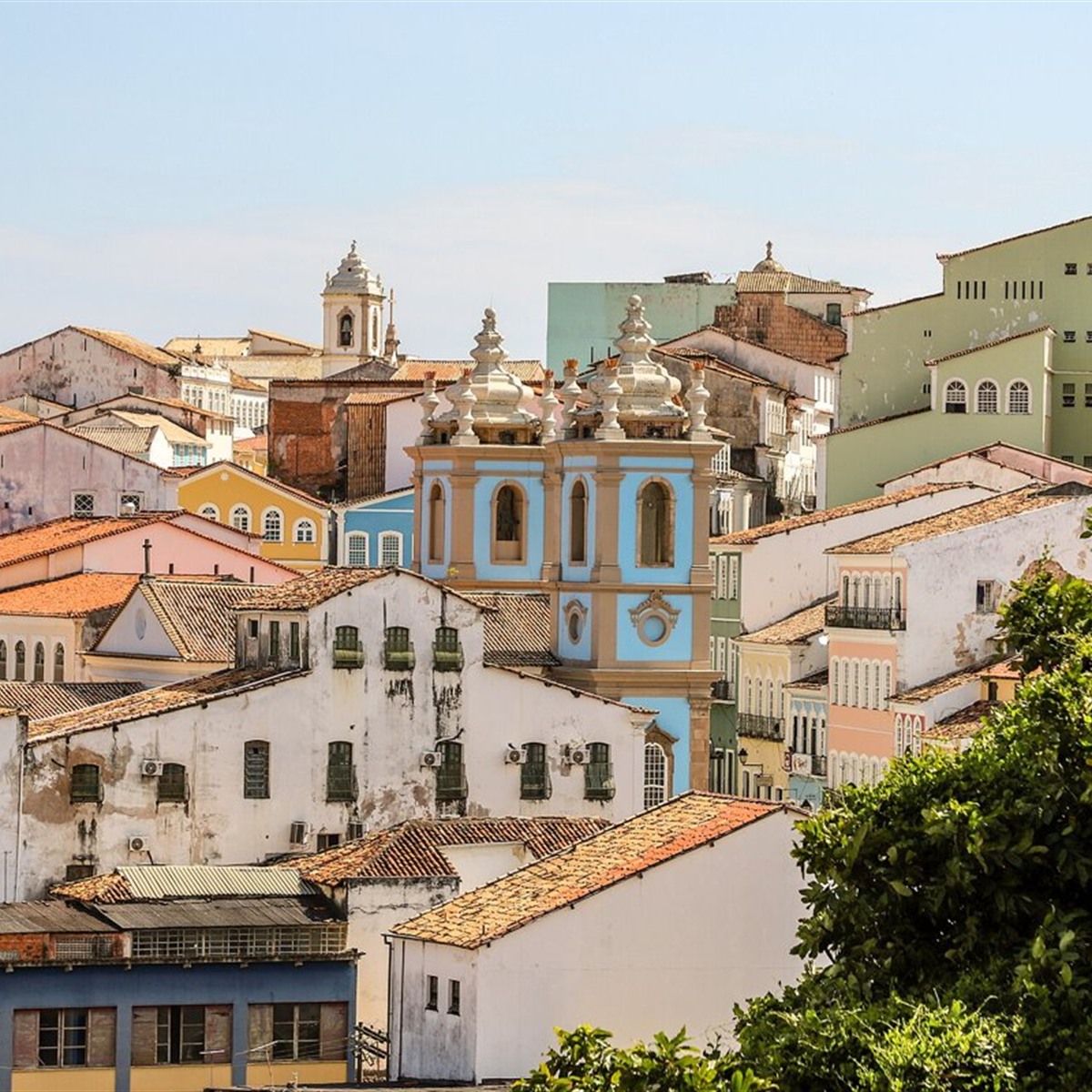
The Pelourinho, Salvador's historic center, concentrates churches, squares and live music in a compact area that rewards wandering without a fixed plan. This is where the city's layers sit on top of one another: colonial architecture, public squares filled with people, and music coming from venues and streets throughout the day and into the night. Because so much is gathered in one place, the Pelourinho is an efficient introduction for a first-time visitor, but it is also a place where the guidebook stops being useful and your ears take over. Walk, stop when something sounds good, stay a while. The neighborhood is also a reminder that in Salvador music is not confined to scheduled performances; it is part of the texture of daily life. To connect what you hear in the streets with what you can play at home, browse the selections in our music catalog.
How to Experience It and What to Listen To
The best way to approach Salvador is to treat the city as a listening itinerary rather than a checklist. Start with axé music to understand the carnival energy, then follow the berimbau into capoeira, where music and movement are one practice. Seek out the blocos afro and their drums and chants, and give the Pelourinho enough unstructured time for live music to find you. Between trips, keep the sound close: our radio is a simple way to stay in the rhythm, and the blog adds context on the culture behind the songs. No special knowledge is required to enjoy any of this, only curiosity and the willingness to stand still for a few minutes when a drum circle forms. Salvador does the rest, because here the heritage is not an exhibit but a daily practice, open to anyone who shows up and listens.
What is Axé music from Salvador da Bahia and how did it emerge alongside samba-reggae?
Axé is an upbeat musical genre born in Salvador da Bahia during the 1980s that fused the Afro-Brazilian percussion of blocos afro such as Ilê Aiyê, Olodum, and Muzenza —pioneers of samba-reggae— with electric trio frevo, Caribbean reggae, ijexá rhythms from afoxés like Filhos de Gandhy, and pop-rock. Its name comes from the Yoruba word àṣẹ, meaning sacred life force and spiritual energy in Bahian Candomblé.
What instruments lead a Capoeira circle in Salvador da Bahia and where can you watch it live?
A traditional Capoeira roda —inscribed on UNESCO’s Intangible Cultural Heritage list in 2014— is directed by three single-string percussion bows called berimbaus (gunga, médio, and viola), supported by the atabaque drum, pandeiros, agogô bell, and reco-reco across both Mestre Pastinha’s Capoeira Angola and Mestre Bimba’s Capoeira Regional. In Salvador, visitors can experience live rodas and drum rehearsals at Largo do Pelourinho, Terreiro de Jesus, Forte da Capoeira at Santo Antônio Além do Carmo, and Rio Vermelho; to discover another iconic Northeastern Brazilian music festival, read our guide to Recife and Olinda: Frevo and Maracatu in Pernambuco.